Wednesday, 21 March 2012

Week 11 - Žižek and the immutable value of money


Slavoj Žižek is a theorist whose work on psychoanalysis, 'after Freud', has managed to make the transfer to contemporary culture. Here, he discusses the claim that Marx 'invented the symptom' in a post-Lacanian tradition, claiming 'According to Lacan, it was none other than Karl Marx who invented the notion of symptom [1]'. He discusses the effect of 'capitalist' values upon the human psyche, suggesting money has become an immutable substance in society, due to its non-degradable properties. This ties into the Marxian idea of the 'fetishism' of elements of culture - Žižek proves that even after a note has been mauled or damaged, it still holds the same fundamental value.

Of course, Žižek differs from Marx on many subjects and actually had his Masters thesis rejected for being 'un-marxist'. He has become a contemporary icon for his famous comedic lectures and unusual behaviour - running for the Presidency of Yugoslavia being a good example. He has carved out a niche as a dissident intellectual, even in the modern mind, campaigning for the popular causes of today


It's interesting to see Žižek participating in modern culture in this way (speaking at Occupy Wall Street). Previous writers of the course, such as Horkheimer and Adorno, have eschewed such an opportunity for their own reasons. It's a great way to end this course, with a writer who not only exists as part of the post-Marxist, post-Lacanian tradition, but who takes his interpretation of these works and submits it to the scrutiny of the campaigners of the modern day.

[1] Žižek, Slavoj, The Sublime Object of Ideology, London, Verso

Wednesday, 14 March 2012

Week 10 - Frantz Fanon and the history of the native

In this chapter, 'Concerning Violence [1]', Fanon deals with the relationship between the colonist and native, discussing the nature of the industrially progressive victor and the 'other', meaning that the two are tied in a relationship of envy/lust and superiority. Therefore we arrive at a 'divided history', where both parties are culturally averse to change, leading inexorably to a state of violence that is inescapable. Violence serves then not only as a release, but as the first and last resort, forming a profitable work of marketed cultural differences.

Frantz Fanon

While reading this, I felt that this was applicable to modern warfare and colonialism. In Haiti and Jamaica; in Iraq and Afghanistan, the relationship of the 'colonist' is unavoidably mired in violence and inequality, with the two sides becoming equally abrasive. There are few profits for the natives - as we are told, 'independence brings no immediate change' - due to the implications of hierarchical rule, which locks the colonists to a positive historical consciousness, and the natives to a negative one.

[1] Fanon, Frantz, 'Concerning Violence' in The Wretched of the Earth, London, Penguin, trans. by Constance Farrington

Wednesday, 7 March 2012

Week 9 - Max Horkheimer, Theodor Adorno and the Culture Industry

Adorno and Horkheimer saw the fundamental operation of humans as a general progression towards reasoned thought, though believed that enlightenment had not yet been reached. Culture is described as a 'commodity[1]' that is affirmed and reaffirmed by public thought. This allows culture to 'cheat' its recipients with endless promises that leave us with a culture determined not by the inherent needs of its members, but by what they can be fooled into believing they want. This moves towards Adorno and Horkheimer's theory of Reification, the process by which culture is 'thingified' and therefore gains a type of divinity or respect that it would otherwise struggle to garner.

In the seminar, we applied this to the idea of 'fixed gender', looking at the ways in which we view women. Adorno and Horkheimer remind us that the things that make an individual 'female' in the public eye are not inherent or innate, meaning that we must establish and isolate the attributes culture imposes on a fixed viewpoint of gender instead of our own natural urge to distinguish the sexes.

This reminded me of the recend furore over 'girl' Lego. The toy has expanded into a range that divides normal Lego (cars, boats etc) from 'girl' Lego (shops, dresses, hairstyles). The identity of the lego my generation grew up with  has now changed, following culture's gender binary, meaning that we can look back and say, 'at seven years old, they only sold 'boy' Lego'.

Furthermore, the things that Lego have chosen to work as 'differentiators' between the gendered dolls are telling - the female doll has a pronounced chest and more sculpted face-shape than the male doll. The hair and clothing are both embellished to a far higher degree. Whereas previous 'female' dolls relied solely upon a different, removable hair-style to distinguish them, we now have a whole range of pseudo-biological differences.


I suppose Adorno and Horkheimer would tell us that imposing genders upon previously unisex dolls is an example of formal freedoms being circumvented by elements of social control. In the Beauty Myth, Naomi Wolf tells us that for every positive feminist action, there is a negative one of social control that takes its place. Lego has taken steps to affirm to little girls that they will always be burdened by their difference, even when they are too young to understand.

[1] Horkheimer, Max & Adorno, Theodor W., Dialectic of Enlightenment: Philosophical Fragments, ed. by Gunzelin Schmid Noerr, trans. by Edmunt Jephcott, Stanford University Press, California, 2002

Wednesday, 29 February 2012

Week 8 - Derrida and friendship

Unfortunately I was sick this week, after struggling through the slightly bizarre Jacques Derridas' 'The Politics of Friendship'. It opens like the lament of a drunken barman -'O, my friends, there is no friend [1].', but thankfully picks up towards the end. Derrida confronted the idea of friendship as 'political', associated with his previous more prominent theory of 'deconstruction'. The famous quote, attributed by Montaigne to Aristotle, functions as a way for Derrida to deconstruct the idea of friendship, leading to the conclusion that friendship is linked to both past and future phases, confusingly telling the reader that a multitude of friends is less 'politically' beneficial than a smaller group.


Since I clearly had some difficulty with this text I was sad to have to miss the seminar - owing to horribe stress-influcted migraines that I'm prone to - so I decided I'd see if I could get a copy of the lecture notes from a friend. However, when I came to try to contact someone, I realised that: yes, I have many friends in that seminar; but no, I don't know any of them well enough to have their phone number. I wondered if this might have been the overwhelming message of Derrida - the importance of having a few, close friends, as opposed to many, distant friends.

[1] Derrida, Jacques, The Politics of Friendship, London, Verso

Wednesday, 15 February 2012

Week 6 - Irigaray and love

Luce Irigaray is a Belgian feminist, famous for being expelled from the Freudian School in Paris. She criticised Freudian theory in 'Speculum of the other woman', discussing theoretical neglect and the social implications of excluding women, who were treated as 'lifeless inessential matter without consciousness[1]'. 'Subjects' are therefore always male - women can only become subjects if they adopt a male subject positioning.

Irigaray therefore positions the female 'other' not as a 'fixed female subject' but as a changing one, leading to a dialogue of differentiated states of being. The difficulties in the relationship of 'love' are more than just a confused psychiatric female identity - Irigaray deals with the idea of the 'constraints of privilege' that disable members of hierarchical levels from countenancing external influences.

Language, therefore, is both Irigaray's path to, and barrier from, the other. In order to traverse the collective idea of 'difference', there must be a philosophy and language that theorises for diversity. Irigaray therefore suggests a new 'language of love' that focuses on verbs instead of 'gendered' nouns. It is key, she tells us, that we should not appropriate the subject - telling the other I love *to* you.


The sad conclusion of Irigaray's work is that there is simply no language capable of articulating our relationship with the other. Not even these love-themed fridge magnets.


[1] Irigaray, Luce, The Way of Love, trans. by Heidi Bostic and Stephen Pluhácek, London, Contiuum

Wednesday, 8 February 2012

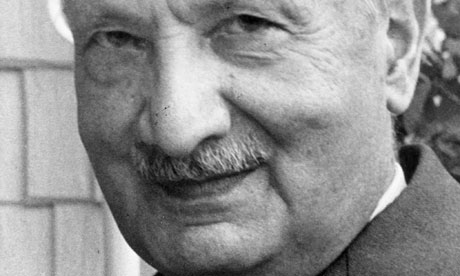
Week 5 - Heidegger and metaphysics


Heidegger presents us with the question 'Why are there beings at all, instead of nothing?'[1]. He goes further, breaking down the question into its elemental linguistic form. He tells us that posing a question of 'nothing' is a heresy of language; that simply by asking about 'nothing', we are making it 'something'. Therefore the most valid question is not 'Why are there beings at all, instead of nothing?', but 'how does it stand with being?', allowing us to confront first and foremost our knowledge and understanding of being, which by its very existence is no longer 'nothing'.

Moreover, the question 'How does it stand with being?' has not been successfully confronted by History or Science, who are more concerned with an 'object of knowledge'. This is a problem also confronted with difficulty by language - the awkward, irregular tenses of the verb 'to be' reflect our inability to first ask the question.

The essay uses language first and foremost to posit the 'correct question'. In a desperate attempt to work out how this could be of any philosophical use, I related it to the famous opening of The Hitchiker's Guide to the Galaxy, where the answer to 'life, the universe, and everything' is, disappointingly, '42[2]'. The supercomputer tells his questioners to look for 'the real question' first, before seeking the answer. I thought this was a good way of looking at the questions Heidegger poses - asking us not to question our origination out of nothing, but question the formation of questioning itself.

[1]  Heidegger, Martin, Introduction to Metaphysics, London, Yale University Press
[2]  Adams, Douglas, The Hitchhiker's Guide to the Galaxy, London, Macmillan, 1979

Wednesday, 1 February 2012

Week 4 - Foucault and Butler

Foucault and Butler are concerned with the way in which 'power' influences human behaviour and thought. They are both interested in the way this is implemented in contemporary society. For Foucault, 'power' can be symbolised as an institution, 'in the context of the school, the barracks, the hospital, or the workshop. He tells us, 'Discipline 'makes' individuals; it is the scientific technique of a power that regards individuals as both objects and as instruments of its exercise [1]'. 


This is more than an analysis of the prison system - Foucault is studying the 'production of the individual'. This was explained in the lecture using the idea of the 'Panopticon', the structure by which members of society, under fear that they are possibly or probably being scrutinised, become self-policing individuals.


This can be applied to a modern-day British psyche. We are constantly aware of the CCTV and various other measures around us, that cause us to watch our own behaviour all the more intently. On my way to work in the West End, I noticed that large blue podiums had been erected in main tourist areas, at the top of which stood police officers.


After a bit of research, I found out that this was an element of 'Operation Trafalgar', which has been 'designed to tackle crime, disorder and anti-social behaviour in the heart of London'. This move to in-person police scrutiny clearly takes its cues from psychological thought, creating a panopticon in the centre of London. The effects are clear - while we are afraid of scrutiny through CCTV, the direct cause to effect framework of punishing a crime is absent, allowing us to 'procrastinate' our concerns about being watched to a later time (perhaps when the police come knocking). Operation Trafalgar, with its highly-visible police force, means that the urge to self-police is much stronger owing to the immediacy of the threat of punishment.

[1] Foucault, Michael, 'Docile Bodies' in The Foucault Reader, ed. by Paul Rabinow, Penguin, London, 1986

Wednesday, 25 January 2012

Week 3 - Kristeva and the language of Silence

Julia Kristeva was born in 1941 in Bulgaria, a communist state at the time. I believe the infuence of Russian communism on her country may have had some influence linguistic studies, which informed her views on the structure of language. After studying under Bahktin, Bart and Golding, she then moved to Paris to further her studies, producing a multi-lingual theory of linguistics.


Kristeva's work on the 'vitality' of language is interesting, and yet somewhat troubling. In the same way as we have seen Kant talking about our interactions with the outside world being limited by our sensory apparatus, I found Kristeva's view of language as a finite, flawed form of communication thought-provoking. This was heightened further after finding out that the second half of Kristeva's book has not been translated due to its emphasis on and usage of the structure of the French language.

From my reading, I considered Kristeva to be making the point that language and reason are not interlinked, and that language is appropriated for our own ends that may deviate from the message to be conveyed. This reminded me slightly of Harold Pinter's use of pauses in his plays. Sir Peter Hall famously said of them that 'a pause in Pinter is as important as a line. They are all there for a reason. Three dots is a hesitation, a pause is a fairly mundane crisis and a silence is some sort of crisis'. 


Perhaps what Pinter was attempting in his pauses was communication sans language. Silence, sensory deprivation and lack of audible stimulation is recognisable no matter what language has been appropriated along the way. I wonder whether Pinter had indeed imported Kristeva's notions of 'appropriated language' and symbolism into a 'semiotic' experience, devoid of grammar or syntax, communicated without language per se.


[1] Kristeva, Julia, Revolution in Poetic Language, trans. Margret Waller, New York, Columbia Press

Wednesday, 18 January 2012

Week 2 - Lacan's Mirror Stage

Jacques Lacan deals with the language of the world - how we understand the world around us from a linguistic viewpoint. He looks at the signified [an image] and the signifier [a concept] and theorises on the arbitrary relationship between the two. He tells us that there is no natural connection between the signified and the signifier - this is established simply by 'convention of language [1]'.
It is, however, impossible to step outside of language, to scrutinise the image or concept, since we are bound within this binary completely by our own visual and verbal apparatus - there is no transparency between the signifier and the signified.


I found the idea of the 'mirror stage' as an interesting way of breaking down this quite difficult concept. Lacan describes it as occuring between the age of 6 and 18 months, and that it is the moment at which the child recognises itself and realises it is an 'independent' being. However, this causes a rupture in the child's persona, splitting the self from the realm of images. This, Lacan tells us, marks the development of the subconscious, since the split is repressed and not reconciled.

[1] Lacan, Jacques, Écrits: A Selection, trans. Alan Sheridan, Hogarth Press 1977

Wednesday, 11 January 2012

Week 1 - The Learning Journal

We began Semester 2 with an introduction to the Architects learning journals, in which we are supposed to record our interactions with the texts and how we associated with them outside of the lecture environment. It is supposed to represent 'personal academic reflection', so I decided to use a 'blog' format to record my musings on the subject.

The plan for the next 10 weeks is to observe and read critics focused on 'modernity', dealing with issues such as -
  • dominance of technology
  • nationality
  • secularisation
  • moral relativism 
  • localised and emergent modernities
  • western and eurocentric concepts
We have previously had a grounding in the works of Marx, Nietzsche and Freud, in order to build up to these more modern critics. During our lecture we also looked at how analytical psychology had largely emerged after defining historical events, showing that Hegel was inspired by the French Revolution. We therefore established the Holocaust as the most contemporary epochal event of the 20th Century, and discussed what ramifications this might have for the relevance of the works we're currently reading. Marx, for example, was once associated with 'freedom', but is now instead a symbol for totalitarianism.  

Hopefully in this blog I will be able to compare the contemporary message of the writers with a more modern interpretation. 200 words is, of course, a limiting factor, and for the weeks in which I found the reading a struggle I'll focus more on the text itself than alternative interpretations. However, I do want to apply these thoughts and ideas to a modern psyche, in order to see how the chronological progression of human consciousness has altered their meanings.

nb - I have decided that in most, if not all, of the posts, I will try and add a little graphic of my own representing the work/s read that week