

In the seminar, we applied this to the idea of 'fixed gender', looking at the ways in which we view women. Adorno and Horkheimer remind us that the things that make an individual 'female' in the public eye are not inherent or innate, meaning that we must establish and isolate the attributes culture imposes on a fixed viewpoint of gender instead of our own natural urge to distinguish the sexes.
This reminded me of the recend furore over 'girl' Lego. The toy has expanded into a range that divides normal Lego (cars, boats etc) from 'girl' Lego (shops, dresses, hairstyles). The identity of the lego my generation grew up with has now changed, following culture's gender binary, meaning that we can look back and say, 'at seven years old, they only sold 'boy' Lego'.
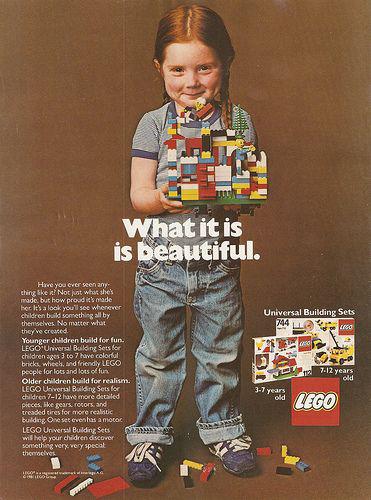
I suppose Adorno and Horkheimer would tell us that imposing genders upon previously unisex dolls is an example of formal freedoms being circumvented by elements of social control. In the Beauty Myth, Naomi Wolf tells us that for every positive feminist action, there is a negative one of social control that takes its place. Lego has taken steps to affirm to little girls that they will always be burdened by their difference, even when they are too young to understand.
[1] Horkheimer, Max & Adorno, Theodor W., Dialectic of Enlightenment: Philosophical Fragments, ed. by Gunzelin Schmid Noerr, trans. by Edmunt Jephcott, Stanford University Press, California, 2002

No comments:
Post a Comment