Wednesday, 21 March 2012

Week 11 - Žižek and the immutable value of money


Slavoj Žižek is a theorist whose work on psychoanalysis, 'after Freud', has managed to make the transfer to contemporary culture. Here, he discusses the claim that Marx 'invented the symptom' in a post-Lacanian tradition, claiming 'According to Lacan, it was none other than Karl Marx who invented the notion of symptom [1]'. He discusses the effect of 'capitalist' values upon the human psyche, suggesting money has become an immutable substance in society, due to its non-degradable properties. This ties into the Marxian idea of the 'fetishism' of elements of culture - Žižek proves that even after a note has been mauled or damaged, it still holds the same fundamental value.

Of course, Žižek differs from Marx on many subjects and actually had his Masters thesis rejected for being 'un-marxist'. He has become a contemporary icon for his famous comedic lectures and unusual behaviour - running for the Presidency of Yugoslavia being a good example. He has carved out a niche as a dissident intellectual, even in the modern mind, campaigning for the popular causes of today


It's interesting to see Žižek participating in modern culture in this way (speaking at Occupy Wall Street). Previous writers of the course, such as Horkheimer and Adorno, have eschewed such an opportunity for their own reasons. It's a great way to end this course, with a writer who not only exists as part of the post-Marxist, post-Lacanian tradition, but who takes his interpretation of these works and submits it to the scrutiny of the campaigners of the modern day.

[1] Žižek, Slavoj, The Sublime Object of Ideology, London, Verso

Wednesday, 14 March 2012

Week 10 - Frantz Fanon and the history of the native

In this chapter, 'Concerning Violence [1]', Fanon deals with the relationship between the colonist and native, discussing the nature of the industrially progressive victor and the 'other', meaning that the two are tied in a relationship of envy/lust and superiority. Therefore we arrive at a 'divided history', where both parties are culturally averse to change, leading inexorably to a state of violence that is inescapable. Violence serves then not only as a release, but as the first and last resort, forming a profitable work of marketed cultural differences.

Frantz Fanon

While reading this, I felt that this was applicable to modern warfare and colonialism. In Haiti and Jamaica; in Iraq and Afghanistan, the relationship of the 'colonist' is unavoidably mired in violence and inequality, with the two sides becoming equally abrasive. There are few profits for the natives - as we are told, 'independence brings no immediate change' - due to the implications of hierarchical rule, which locks the colonists to a positive historical consciousness, and the natives to a negative one.

[1] Fanon, Frantz, 'Concerning Violence' in The Wretched of the Earth, London, Penguin, trans. by Constance Farrington

Wednesday, 7 March 2012

Week 9 - Max Horkheimer, Theodor Adorno and the Culture Industry

Adorno and Horkheimer saw the fundamental operation of humans as a general progression towards reasoned thought, though believed that enlightenment had not yet been reached. Culture is described as a 'commodity[1]' that is affirmed and reaffirmed by public thought. This allows culture to 'cheat' its recipients with endless promises that leave us with a culture determined not by the inherent needs of its members, but by what they can be fooled into believing they want. This moves towards Adorno and Horkheimer's theory of Reification, the process by which culture is 'thingified' and therefore gains a type of divinity or respect that it would otherwise struggle to garner.

In the seminar, we applied this to the idea of 'fixed gender', looking at the ways in which we view women. Adorno and Horkheimer remind us that the things that make an individual 'female' in the public eye are not inherent or innate, meaning that we must establish and isolate the attributes culture imposes on a fixed viewpoint of gender instead of our own natural urge to distinguish the sexes.

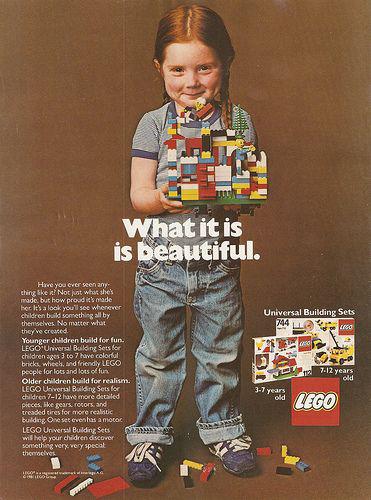
This reminded me of the recend furore over 'girl' Lego. The toy has expanded into a range that divides normal Lego (cars, boats etc) from 'girl' Lego (shops, dresses, hairstyles). The identity of the lego my generation grew up with  has now changed, following culture's gender binary, meaning that we can look back and say, 'at seven years old, they only sold 'boy' Lego'.

Furthermore, the things that Lego have chosen to work as 'differentiators' between the gendered dolls are telling - the female doll has a pronounced chest and more sculpted face-shape than the male doll. The hair and clothing are both embellished to a far higher degree. Whereas previous 'female' dolls relied solely upon a different, removable hair-style to distinguish them, we now have a whole range of pseudo-biological differences.


I suppose Adorno and Horkheimer would tell us that imposing genders upon previously unisex dolls is an example of formal freedoms being circumvented by elements of social control. In the Beauty Myth, Naomi Wolf tells us that for every positive feminist action, there is a negative one of social control that takes its place. Lego has taken steps to affirm to little girls that they will always be burdened by their difference, even when they are too young to understand.

[1] Horkheimer, Max & Adorno, Theodor W., Dialectic of Enlightenment: Philosophical Fragments, ed. by Gunzelin Schmid Noerr, trans. by Edmunt Jephcott, Stanford University Press, California, 2002